
The Insurance Companies May Be Deciding Who's At Fault. The Impound Yard Isn't Waiting For Them.
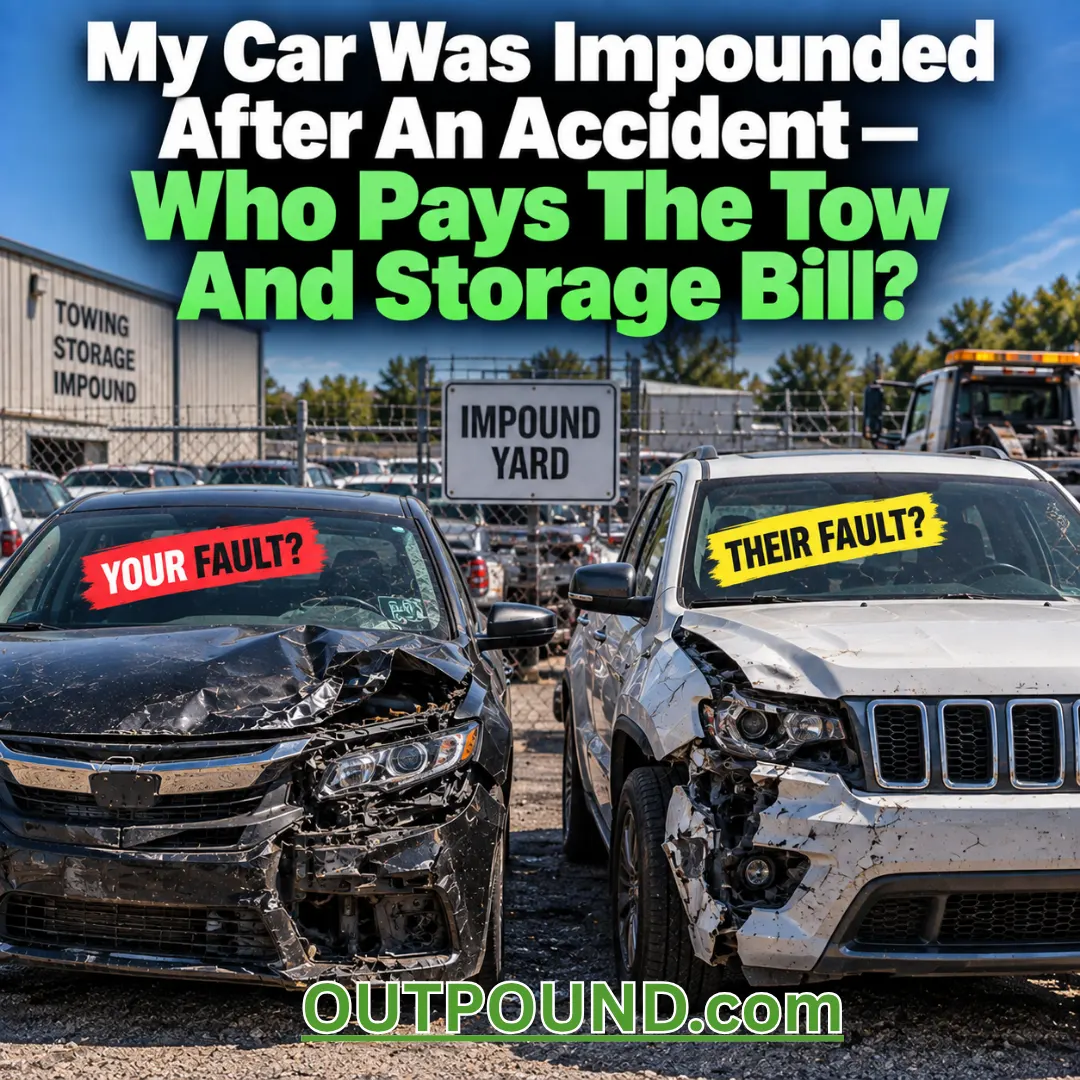
Your car has just been wrecked badly enough that it can't be driven away. Police clear the accident scene, a tow truck takes the vehicle to an impound or storage facility, and now you're dealing with insurance adjusters, accident reports, transportation problems and a damaged vehicle you may not even want back.
Then comes another problem: the tow and storage bill. Who pays it?
The answer depends heavily on who caused the accident, what insurance coverage is available, state law and how quickly the damaged vehicle is dealt with. What you should never assume is that because an insurance claim has been opened, somebody else has automatically taken responsibility for every dollar accumulating at the storage facility.
Insurance may still be investigating. The impound yard may still be charging.
SCENARIO #1: YOU CAUSED THE ACCIDENT
Suppose you lose control of your vehicle, cause the collision and your badly damaged car gets hauled away from the scene.
If you're responsible for the accident, don't expect the other driver's insurance company to pick up the towing and storage expenses for your vehicle. Your own insurance coverage becomes the first place to look.
If you carry applicable collision coverage, reasonable towing and storage expenses associated with a covered accident may be handled as part of the claim, depending on your policy and applicable law. Your insurer may inspect the vehicle and then decide whether it should be repaired, declared a total loss, transferred to another facility or moved to a salvage location.
But insurance coverage isn't permission to forget where the vehicle is sitting. If the insurer tells you the vehicle needs to be released or moved and you fail to cooperate, there may come a point when additional storage expenses are no longer considered reasonable or covered.
That's when your accident can become your tow bill, your storage bill and potentially your financial headache.
SCENARIO #2: THE OTHER DRIVER CAUSED THE ACCIDENT
Now imagine you're completely innocent. You're stopped at a red light when another driver plows into you and destroys your vehicle.
Their fault. Their insurance. Their bill. Sounds simple, RIGHT??
Unfortunately, insurance claims don't always move that quickly.
The other driver's insurer may investigate before accepting liability. The company could be waiting for statements, photographs, the police report or additional information. Fault might even be disputed despite what seemed obvious at the accident scene.
Meanwhile, your damaged vehicle is still occupying space at a storage facility.
| Accident Situation | Where Payment May Come From |
|---|---|
| You caused the crash | Your applicable insurance coverage |
| Other driver caused it | At-fault driver's liability coverage may ultimately apply |
| Fault is disputed | Responsibility may remain unresolved while charges accumulate |
| You use your collision coverage | Your insurer may handle the covered loss and pursue recovery |
| Vehicle remains unnecessarily | Some continued storage expenses could become your responsibility |
Insurance policies, towing laws, storage rules and claims procedures vary by state and individual circumstances. ____________________________________________________________________________
If the other driver's insurer eventually accepts liability, reasonable towing and storage expenses may be recoverable as part of the property-damage claim. But being the innocent driver doesn't necessarily mean you can leave the vehicle sitting indefinitely while the insurance companies sort everything out. You may still have a responsibility to take reasonable steps to prevent unnecessary expenses from continuing to pile up.
THE WORST THING YOU CAN DO IS ASSUME SOMEBODY ELSE IS HANDLING IT
Find out where your vehicle was taken immediately. Ask the facility what you're currently being charged, whether storage is accumulating daily and what is required to release or move the vehicle.
Then contact the appropriate insurer and tell them exactly where the vehicle is located. Ask what they want done with it and document those conversations. If the car is severely damaged, however, another question deserves consideration:
Does getting this vehicle back even make financial sense?
A badly wrecked vehicle can become an ugly equation involving towing charges, storage fees, insurance deductibles, repair estimates, diminished value and possibly an outstanding auto loan.
At some point, spending more money simply to regain possession of a vehicle you no longer want may not be the smartest move.
BEFORE THE STORAGE BILL GETS WORSE, CONTACT OUTPOUND
If your damaged vehicle is sitting in an impound facility and the bills are accumulating, OUTPOUND may be able to help you sell the vehicle directly from impound.
Vehicle condition, ownership documentation, liens, payoff amounts, insurance status and the facility's requirements can all affect what's possible. But you don't necessarily have to assume that paying a growing bill just to drag a wrecked vehicle home is your only option.
Whether you caused the accident or somebody else did, deal with the vehicle quickly.
The crash may have lasted five seconds. The financial wreckage can keep growing every single day the vehicle sits in impound.